At LiFE Multi Academy Trust, we believe education should do more than help young people achieve academic success. It should prepare them to thrive in an increasingly complex and interconnected world. That is why we have developed and implemented the Real Life Curriculum – an innovative approach to teaching and learning that combines academic rigour with real-world relevance.
What is the Real Life Curriculum?
The Real Life Curriculum is a research-informed approach to education designed to equip learners with the knowledge, skills and values needed for success in the 21st century. While students continue to study all national curriculum subjects through dedicated lessons, the curriculum goes beyond traditional models by helping learners make meaningful connections between different areas of learning.
Rather than seeing subjects as isolated disciplines, students are encouraged to understand how knowledge can be applied to real-life situations and global challenges. The result is learning that feels more relevant, engaging and purposeful.
What’s the benefit?
Education is evolving. Employers, universities and society increasingly value skills such as collaboration, problem-solving, self-management, communication and adaptability alongside academic achievement.
The Real Life Curriculum has been designed to respond to this need. By combining strong subject knowledge with opportunities to apply learning in authentic contexts, it helps students develop the confidence and capabilities they need to make a positive difference in their own lives and in the wider world.
Our approach is grounded in global educational research and recognises that learners are most engaged when they understand the purpose behind what they are studying. When students can see how classroom learning connects to genuine issues and challenges, motivation and engagement increase.
The key ideas
The Real LiFE Curriculum is built around three key elements:
Interdisciplinary Missions
Two or three times each year, students take part in a Mission based on one of the United Nations Global Goals. These missions challenge learners to explore real-world issues such as climate change and develop thoughtful responses or potential solutions.
Students draw upon knowledge from multiple subject areas, applying what they have learned in meaningful ways. This helps them see the bigger picture and understand how learning from different disciplines can work together to address real challenges.
Each mission culminates in a final product, showcase or exhibition where learners present their work and explain their thinking, giving them an authentic audience and purpose for their learning.
CREW
At the heart of the curriculum is CREW – Coaching, Reflection, Enrichment and Well-being. These dedicated sessions provide time for students to set personal goals, reflect on their progress and receive personalised coaching from staff.
CREW Leaders work closely with learners, helping them develop independence, organisation, resilience and problem-solving skills. The process is built around goal setting, action and reflection, empowering students to take greater ownership of their learning journey.
Visible Success and Feedback
Students regularly use clear rubrics and success criteria to understand what high-quality work looks like. They are encouraged to evaluate their own progress and provide constructive feedback to others using prompts such as “I like…”, “I notice…” and “I wonder…”.
This approach develops self-reflection, builds confidence and helps create a culture where feedback is kind, specific and genuinely supportive of improvement.
The Benefits for Learners
The Real Life Curriculum offers a range of benefits that extend beyond academic outcomes:
- Greater engagement through learning that has real-world relevance and purpose.
- Stronger problem-solving skills developed through tackling authentic challenges and complex questions.
- Improved independence and organisation through goal setting, coaching and reflection.
- Enhanced self-confidence through regular opportunities to showcase learning and evaluate progress.
- Better collaboration and communication through peer feedback and mission-based learning.
- A broader understanding of the world through engagement with global issues and the UN Global Goals.
The Impact
The ultimate impact is that students become more than successful learners—they become confident, reflective and proactive young people who understand how their education connects to the wider world.
By blending academic knowledge with real-world application, personalised coaching and opportunities for meaningful reflection, we are helping learners develop the attributes they need not only to achieve in school, but to thrive long after they leave it.
The Real Life Curriculum embodies our commitment to ensuring education is both ambitious and relevant, preparing every learner for the opportunities and challenges of the future.
Article by Nicola Koncarevic – Deputy CEO LiFE Multi Academy Trust & Philip Robinson – CEO Tide Education
Over the summer term LiFE Multi Academy Trust, a Leicestershire based Education Trust supporting 12 education provisions, undertook a trial with Tide Education, an intervention tracking platform, across two secondary schools to help answer a simple but important question: What could we learn if every piece of support provided to students was made visible? How can data support a better collaborative, whole school approach to inclusion, amplify the impact, and enable better outcomes for students?
The result was a picture of school life that is not currently captured in traditional datasets.
A Trust Perspective
By Nicola Koncarevic – Deputy CEO LiFE Multi Academy Trust
At LiFE Multi Academy Trust, our responsibility extends beyond identifying need; it is about ensuring every child receives the right support at the right time. The challenge is that much of the support schools provide every day sits outside traditional reporting systems. We can see outcomes, attendance figures and SEND designations, but we cannot always see the full picture of what is being done across a school to help a young person succeed.
Targeted interventions serve as a critical bridge between policy directives and tangible student outcomes; however, the absence of systematic recording transforms educational frameworks into administrative burdens, rather than a pathway to progress. While major policy initiatives, including the schools’ white paper, “Every Child Achieving and Thriving,” the SEND reform plans, the enrichment framework, and the Ofsted Inspection Toolkit, mandate rigorous evidence-based approaches, school leaders frequently struggle to consolidate intervention data. Relying on a disjointed array of management information systems, spreadsheets, notebooks, and informal meeting notes, often results in a fragmented approach that can undermine the delivery of timely and effective support.
A coordinated approach to intervention is essential to prevent the duplication of support by multiple staff, maximising limited resources such as time and budgets. Helping identify provision gaps across year groups, ensuring continuity of care during transitions, and providing a holistic view for every learner is also key for effective interventions.
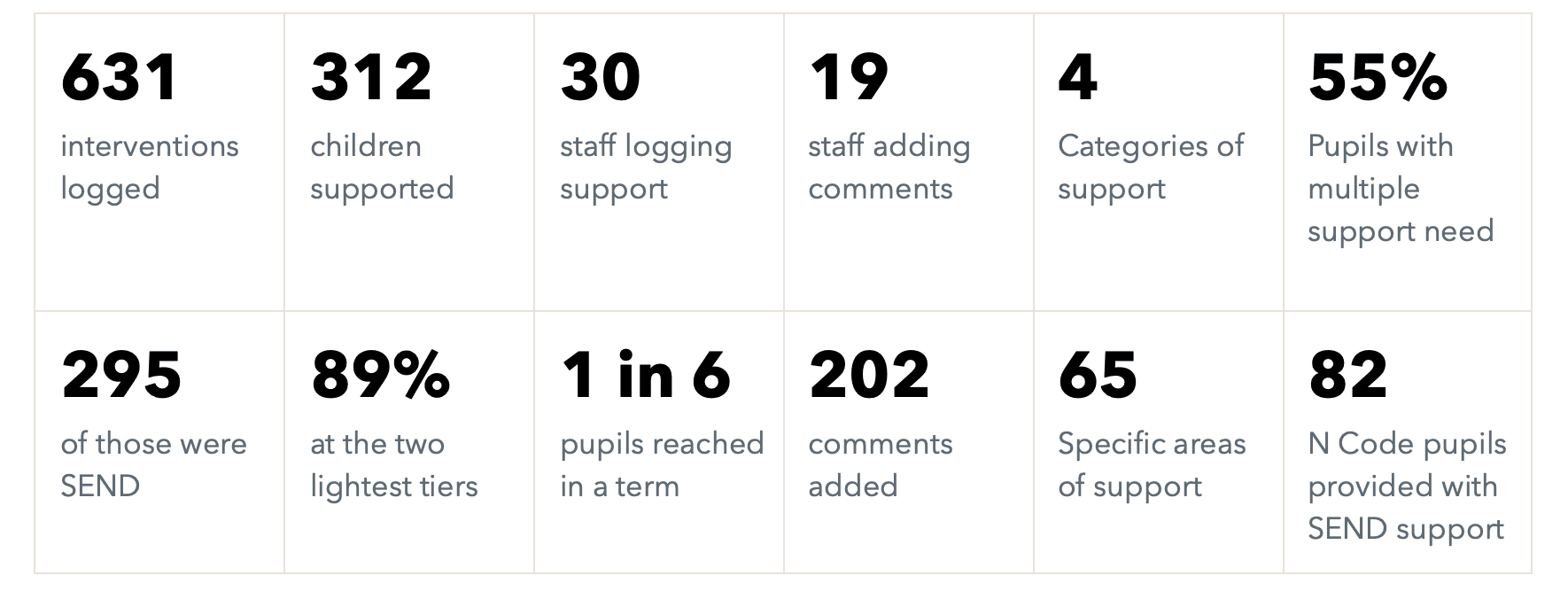
This report shares the initial findings from 631 recorded support interventions across the two schools, prompting a critical examination of how these schools are evolving their strategic methodologies.
The impact so far has been immediate. Staff could see the complete package of support around a child, reducing duplication, strengthening collaboration between SEND, attendance, safeguarding and pastoral teams, and enabling earlier, better-informed decisions. We began to identify students receiving significant levels of support before they met formal thresholds for intervention. Early indicators, particularly within attendance-focused interventions, suggested improvements for a number of pupils, while the visibility of existing support helped us maximise resources already in place before considering additional or more costly interventions.
This pilot is just the beginning, the information emerging is directly impacting on the interventions needed to support our trust graduated response, and all six secondary schools will be engaging with the Tide Education platform next academic year.
The data showing the big picture
The trial set out to capture something education systems rarely see: the actual support students receive every day.
Across two secondary schools, approximately 2,000 students and one summer term, the platform captured 631 interventions, delivered by 30 staff members, supporting 312 students across 65 distinct areas of need and four categories of provision. It generated a shared, live picture of support activity that would otherwise remain fragmented across teams, systems and individual staff knowledge.
Looking Beyond Labels
The most significant finding was that support frequently starts before a student acquires a formal designation.
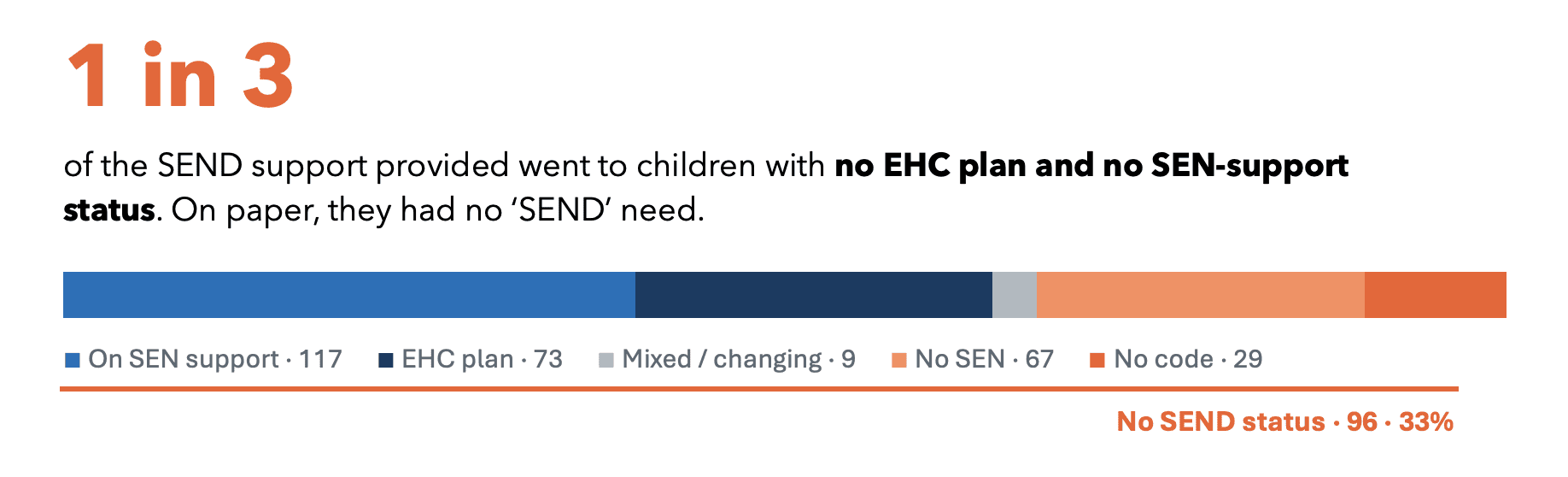
Of the 295 SEND interventions recorded, 105 were delivered to 82 students with no recorded SEND need, meaning around one-third of SEND provision was directed towards students who had neither an EHCP nor SEN Support status.
These students were already receiving practical support through interventions such as One Page Profiles and Supportive Passes, demonstrating that schools routinely respond to emerging need before it appears in statutory datasets.
Understanding Complexity Earlier
The platform also revealed how support requirements increase alongside need.
- 63 students on SEN Support received 117 interventions.
- 27 students with EHCPs received 73 interventions.
- 48% of students without SEND status received multiple interventions.
- 57% of students on SEN Support received multiple interventions.
- 100% of students with EHCPs received multiple interventions.
This level of visibility allows schools to identify students whose needs are changing, monitor the effectiveness of support and better understand the transition points between universal, targeted and specialist provision.
Demonstrating the Scale of Early Intervention
One of the clearest insights from the trial was the volume of preventative support taking place within schools.

In total, 564 interventions (89%) sat within the earliest two tiers of support. Rather than activity being concentrated around specialist provision, the data demonstrated that most support occurs through low-cost, early intervention strategies intended to prevent escalation and improve outcomes before needs become more complex.
One Platform, Multiple Areas of Need
The platform was designed to move beyond isolated views of SEND and provide a whole-child perspective.

The findings show that student needs rarely exist in isolation. Attendance concerns, safeguarding issues, behavioural challenges and SEND frequently overlap. Bringing these together into a single view enables schools to coordinate support more effectively and make decisions based on a fuller understanding of a student’s circumstances.
What Support Is Actually Being Delivered?
The most frequently used interventions were:
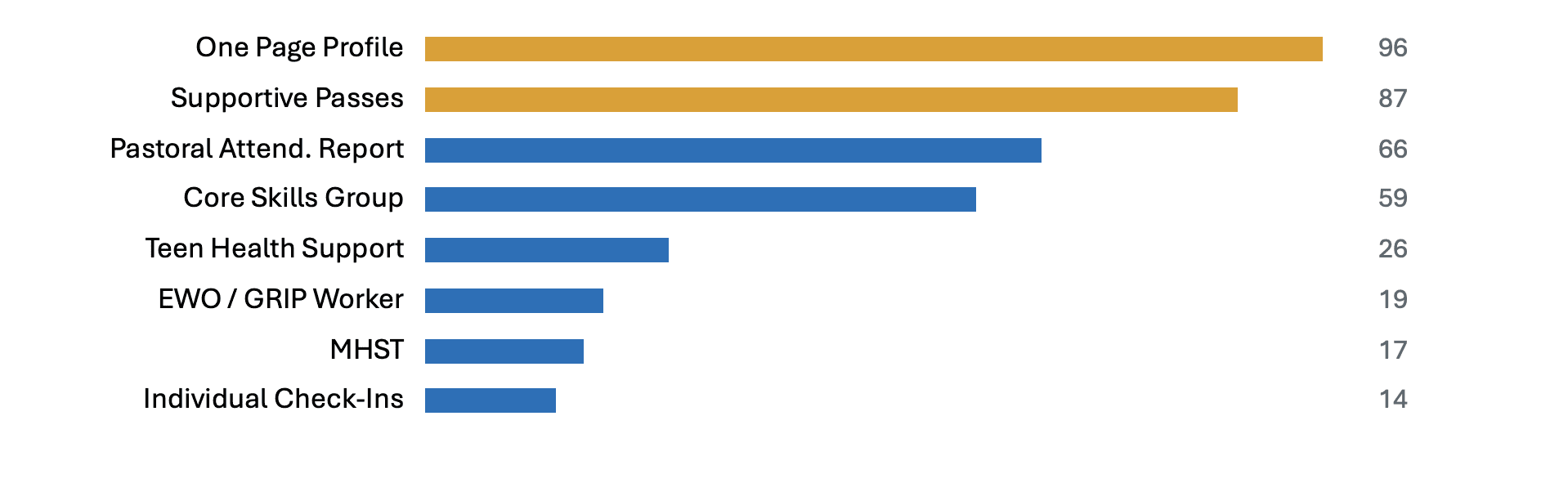
The platform also captured support delivered by external partners, including Mental Health Support Teams, attendance services, CAMHS, social care and other agencies, creating a unified timeline of provision around each child.
Caveats
It’s early days, 2 schools, one term and with the ability to record impact and effectiveness (via professional judgement), as well as the duration of the support provided, along with the time staff spend on the support; over time, there is far more the data can tell us about the support provided, the impact is has had for the students and how the information can be used to develop and inform the support provided.
Whilst it is too early to prove categorically the support provided had a direct impact, there have been early, demonstrable, signs around attendance interventions where a marked improvement was seen for a number of pupils. With more education technology providers adopting an Open Architecture, the ability to unite support information with the standard MIS datasets, along with others, presents opportunities to better understand what support works for who and when.
This trial also identified areas where the data in the MIS requires attention, such as with the SEN Codes, and therefore there may be a variance in the percentages presented.
Conclusion
For Trust leaders, the impact was greater visibility, stronger collaboration, earlier intervention and better use of existing resources. For schools, it created a shared understanding of every student’s support journey. For Tide Education, it demonstrated the power of making support visible.
The trial showed that schools are already doing significant work before formal labels are applied. By capturing and connecting that activity, leaders gain the evidence needed to understand what support is being provided, who is benefiting from it and where resources can have the greatest impact. Data isn’t the outcome; understanding and the provision of support is.
The labels tell part of the story. The support tells the whole story.